The Sad Little Stop Sign: A Rant Against Bad Driving Invented Spontaneously While on a Family Road Trip, Delivered Loudly and Angrily to All Passengers as if Telling a Story But Actually Just Venting Because the Driver Was Super, Super Pissed

By David Templeton

At a place in the country where a narrow road meets a wider road near a big green tree, a little stop sign stood straight and still and plain and simple and silent and red. At first, it was very, very happy, ready to stop any car turning from the narrow road onto the wider road. Though it was not a very big or hard or fancy job, to the little stop sign, it was enough, and it wanted to do the job as well as it could.

But soon the little stop sign became sad, and then sadder, and then even sadder than that — because no cars driving on the narrow road ever stopped at the sign.

“Why are you sad, little stop sign?” asked the big green tree at the side of the road.

“I am sad because no car will stop for me,” said the sign. “Every day, I stand straight and still and red, but when cars drive up on the narrow road, the drivers of the cars only slow down a little and then turn onto the wider road as if I was not standing here telling them to stop.”

“Why do you think the drivers never stop, little stop sign?” asked the tree.

The little stop sign thought about this.

“Perhaps it is because I am too little,” it replied. “If I was taller, then the drivers would stop for me. Maybe if I had a long piece of wood, I could be very tall, and then people will stop and I will not be so sad.”

“I do not think that is why the people do not stop for you,” said the tree. “But here is a long piece of wood I do not need anymore. You may have it to make yourself taller.”

So, the sign took the wood and made itself taller, but still the cars would not stop.

“Little stop sign,” said the tree. “Are you still sad?”

“Yes, I am still sad,” said the tree. “I am taller now, but still the drivers will not stop.”

“Why do you think the drivers will not stop?” asked the tree.

“Perhaps I am the wrong color,” said the sign. “If I was yellow or pink or blue or green, instead of being red, I am sure the cars would stop for me.”

“I do not think that is why the people still will not stop for you,” said the tree. “But here are some cans of paint that fell off a truck. You may use it to paint yourself a different color.”

So, the sign took the paint and made itself yellow, but still the cars would not stop. Then it made itself pink, but even then the cars would not stop. So it made itself blue, and then green, and still they would not stop.

“Little stop sign,” said the tree. “Are you still sad?”

“Yes, I am still sad,” said the tree. “I have been yellow and pink and blue and green, but the drivers will not stop.”

“Why do you think the drivers will not stop?” asked the tree.

“Perhaps I am too straight and still and plain and simple,” said the sign. “If I could bounce up and down and make noise and flash very bright light at the cars, I am sure they would stop for me.”

“I do not think that is why the people still will not stop for you,” said the tree. “But here is a bouncy trampoline and a trumpet and some carnival lights that were left behind when a small traveling circus stopped here a long time ago. You may use them to bounce up and down and make noise and flash bright light at the cars.”

So, the sign took the trampoline and the trumpet and the carnival lights and when cars came driving down the narrow road it bounced up and down and made lots of noise and flashed bright light at them.

But, though some of them did slow down just a little bit more than usual, the cars did not stop.

“Little stop sign,” said the tree. “Are you still sad?”

“Yes, I am still sad,” said the tree. “I have made myself taller. I have changed my color to yellow and pink and blue and green. I have bounced up and down and made noise and flashed lights at the drivers, but still the cars will not stop. I think I will never be happy again.”

“Little stop sign,” said the tree. “It was never because you were too little or too straight and still or too plain and simple or too silent or too red that the cars will not stop for you. They will not stop because some people are assholes. Whenever a car does not stop, just say, ‘Screw those people,’ and go right on doing your job the best you can. And perhaps that will be enough.”

The little stop sign thought about this and understood that the tree was right.

So, from then on, every time a car came driving down the narrow road, the sign stood straight and still and plain and simple and silent and red, and when car did not stop, the sign thought, “Assholes” and sometimes said, “Screw those people,” and went right on doing its job.

And even if the little stop sign was not always very, very happy, at least it was no longer sad – and that was enough.
Bathing in words as a spiritual practice

When I am preparing to write a play, there are a number of actions I take to put myself in the right headspace. I do copious amounts of research, of course, especially if I am writing about something I was not previously that familiar with.
Which – unless I am writing apiece that is overtly autobiographical – is often.
With “Featherbaby,” because the two humans are competitive jigsaw puzzlers, I went deep into jigsaw puzzles. I read everything written about jigsaw tournaments. I searched journalistic texts, the local library and various Facebook groups to learn about the culture, lingo and history of of jigsaw puzzles.
And of course (aided by the pandemic’s having isolated me in a semi-empty house for months) I worked a lot of jigsaw puzzles.
When I wrote “Mary Shelley’s Body” (stay tuned for an announcement about an upcoming production in Northern California), I read “Frankenstein” and most of Shelley’s other books, I read the poetry of Percy Bysshe Shelley and Lord Byron, I read the journals of Mary Shelley and just for good measure, some of the books her parents wrote. I studied “Gray’s Anatomy” for details about the workings of the human body. I watched videos of surgeries and dissection. I listened to recordings of classical music that was popular during Mary’s life, and read newspapers from the time.
So I do all of that.
But this is just the intellectual preparation.
To get myself emotionally ready for writing a new play, I do other things. I try to get in shape, eat well and get good sleep, because writing obsessively is a physical act as much as it is a mental one. I make a mixtape of music that I feel might put me in the right frame-of-mind, and then I play it while musing about the story or sketching characters or writing drafts of scenes. Not only is it nice, I think it creates a kind of Pavlovian trigger, so when I start to play that CD, my brain understands what is about to be required of it and drops me immediately back into the act of creating that particular play. And I have lots of long conversations with friends where I tell them about the play I will soon be starting, because that is where the writing really begins: telling the story to people. I discover a lot, decide a lot, invent a lot, all by talking about a project before I’ve written a word.
But before any of that happens, I do something that might seem odd. In fact, I have yet to hear of another writer, in any medium, who does something similar.
I memorize something.
Usually, it’s something relatively short, because it can take months to memorize something really length, like a play or the chapter of a book. During the pandemic, because I had extra time on my hands, I memorized an entire chapter from “The Wind in the Willows.” Because it was a time of fear and uncertainty, I needed to be steeped in something distractingly beautiful, and “The Piper at the Gates of Dawn” had always struck me as the most gorgeously written part of Kenneth Grahame’s book. In the past, just for fun, and to get my mind tuned to the connectivity and music of words, I have memorized (at various points in my life) a long list of texts, including the following.
The poem “Invictus.”
The “dead in a box” speech from “Rosencrantz and Guildenstern are Dead.”
The full preface to John Steinbeck’s “Cannery Row.”
Numerous song lyrics, including the entire first album from Bruce Springsteen’s “The River.”
Lots of Shakespeare, including (most recently) the part from “Henry V” where the list of English dead is read out to the king.
The “I’m gonna tell you somethin’ you already know” speech from “Rocky Balboa.”
The U.S.S. Indianapolis speech from “Jaws.”
Various other monologues and passages from “When Harry Met Sally,” “Love Actually,” “Altered States,” “The Stunt Man,” “The Muppet Movie” and “The Martian.”
When gearing up to write a play, there is no rhyme or reason for what I choose to memorize, and tot all the truth, it is not as planned out as when I start researching a top or preparing a playlist. It’s more something I find myself doing almost before I know I’m ready to start writing. It’s one of the signs that I need to produce something, akin (I suppose) to a woman suddenly needing to consume particular foods before she knows she is pregnant. It’s part of the creative birth process, for me, I have decided.
And it’s happening again.
I have recently begin memorizing the “‘Death’ … capital D .. ‘Thou shalt die'” speech from the play “Wit.” And as an appropriate pairing, I am going to memorize the full John Donne sonnet (Holy Sonnet No. 6) that the “Wit” speech refers to. It’s the one that begins, “Death, be not proud …”
If you’ve noticed a certain pattern, with my memorization choices often having to do with death, guilty as charged, though I would argue that it’s the beauty and brilliance of the language that attracts me even more than the topic. If something happens to be about death, that’s just gravy.
Death, I have discovered, inspires far better poetry – as a topic – than does love, the other main focus of interest in the pieces I’ve elected to memorize.
The “Cannery Row” piece is not really about either one.
It’s just awesome.
From memory, I now demonstrate:
“Cannery Row, in Monterey, in California, is a poem, a stink, a grating noise, a quality of light, a tone, a habit, a nostalgia, a dream. Cannery Row is the gathered and scattered; Tin and iron and rust and splintered wood, chipped pavement and weedy lots and junk heaps; honkytonks and restaurants and whore houses, little crowded groceries and laboratories and flophouses. It’s inhabitants are, as the man once said, whores, pimps, gamblers and sons of bitches. Had the man looked through another peephole he might have said, Saints and angels and holy men, and he would have meant the same thing.”
I think what this does, for me – aside from exercising the memorization muscles in my brain enough to convince me that I am not yet approaching the memory-loss phase of my life – is to bathe myself in beauty. I think it’s the same with people who find peace and wisdom by walking in the woods, or praying/meditating/exercising in some gorgeous or appropriately inspiring space.
I suppose that learning by memory the most brilliantly written words I can find is my version of a spiritual practice.
It’s about the pursuit of beauty and brilliance.
It’s about bathing oneself in the thing one needs.
When I am about to write a play, I bathe myself in words. I soak them up, drink them down, allow myself to float in them and one them and through them, and to let them course through me.
I’m not quite ready to start writing a new play yet.
But I’m getting close.
I’ll let you know when I start.
Until then, I have a scene and a sonnet to memorize.

Shifting biographies

A couple of years ago, I joined a large online group of playwrights created to support one another’s work by holding two month-long “binges” each year, during which everyone attempts to make at least one step forward in their writing career each day for 30 days. We are currently half-way through one of those months.

Originally, the goal was to submit a play to at least one theater company or playwrights festival each day, but in recent years, the definition of the group has changed a bit. Now, in addition to submitting to various opportunities and sharing those opps with the rest of the group, we are encouraged to spend time marketing ourselves as writers. Regular “prompts” are given, with suggestions of small actions that can be taken, things like reaching out to directors we’ve worked with in the past to share recent successes, or to update a website, or – and this is what I want to talk about right now – take a look at our professional bios and make any changes that seem prudent or appropriate.

I am someone who especially needs this prompt.

I have been very bad at updating my biography. It’s important because you never know when someone will ask for it. Applying for a fellowship to a writing retreat or conference, for example, routinely includes the step of submitting a bio. Should a play land a production, the company putting on your show will likely ask for your bio to include in the program. I was recently asked to provide a current bio for a hosting gig I will have at a movie theater, where I will be introducing a film and conducting the post-film interview with a special guest.

I used to have a standard bio I would immediately cut and paste when asked for it, but these days, I slow down and give the thing a read-through with fresh (in other words, “older”) eyes. It can be a humbling experience to read a bio you wrote two or five or ten years ago. The one I recently re-worked was so LONG, and so eager to please, I thought upon reading it for the first time in years. It read, to me, like it was written by someone who didn’t trust their own history and experience enough. It felt a little “desperate,” as if the goal was to convince someone of something about me rather than simply provide the unvarnished facts and trust people to come to the right conclusion about me from such information.

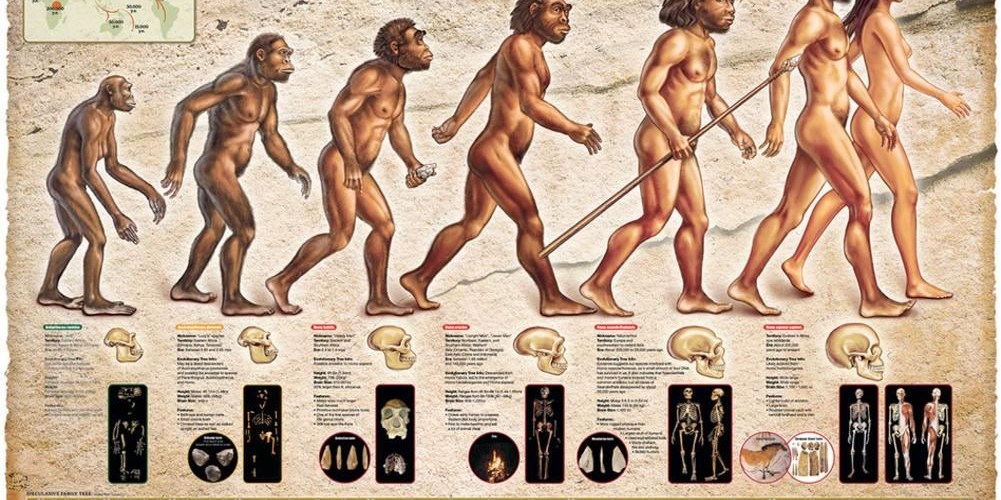
Of course, this is how I always feel when reexamining a previously written bio. You know that famous illustration of human evolution, showing our development, in specific stages, from primate to “modern man”?
That’s what if feels like to read through the various, ever-shifting biographies I’ve written over the last few decades. It can be daunting. It can be embarrassing.

But that doesn’t matter.

In the same way that we playwrights ought to always be working on our craft, we should always be working on our biographies. Because as we change and grown and age and improve, our understanding of what we’ve experienced, and which parts are more important than other parts, also develops and improves.

So regardless of my discomfort, I’ve decided to tackle my own bio once again. Within a few days, it should be up on this website, replacing the previous one. Will it be better than that last one, and the one before that? I certainly hope so. That’s the whole point, isn’t it?

New project: Adapting ‘Pinky’ for a teenage cast

It was just about 14 years ago (March of 2012) that my two-actor play ‘Pinky’ debuted. Easily my most successful play to date, in terms of productions its had since then, ‘Pinky’ features two adults (35 to 55) taking turns telling a story about when they were fantasy-loving, Dungeons-and-Dragons’ playing teenagers. One has a crush on the other. One isn’t so sure. Both are obsessed with “The Beauty and the Beast.” One dreams of the perfect romance, and has a list of ten attributes that person will have. The other has only seven of those attributes, and vows to transform themselves into the person of their loved-one’s dreams. Treasure hunts are involved. It gets crazy. It’s a lot of fun.

Throughout the play, each actor slips back and forth between their adult narrator self and their teenage self. Whenever the story involves their teenage friends, they transform into them, too. It’s a real tour-de-force, and it’s proven to be an attractive challenge to actors eager to stretch themselves to playing seven or eight different characters in the same show. I know from experience, this is a hard show to perform, but that’s one of the things that actors love about it.

And audiences have loved it just as much, young and old. Because of the subject matter, teenagers are often a big part of those audiences. Scenes from the script have even been used as acting and directing exercises in high school and college theater classes.

And routinely, what I hear from young actors is, ‘I wish this were written for teens to perform, because it’s about our lives.’ Of course, it’s NOT written that way, so older actors end up having all the fun. And it is fun. In its world premiere at Sebastopol’s Main Stage West, and again a year later in a production at Santa Rosa’s 6th Street Playhouse – both under the direction of Sheri Lee Miller – I played the part of David and Liz Jahren played the part of Pinky, and neither of us were teenagers at the time.

Well, after more than a dozen years, I’ve decided there’s no reason there couldn’t be TWO versions of ‘Pinky,’ so I am currently in the process of adapting my own play, transforming it from a two-hander for adults into a 12-person play for two adults (the narrators) and 10 teens playing all of the young characters, including a young David and Pinky. It is my hope that this new version will make it possible for high schools and colleges to present the show.

What’s fun about this is the freedom it gives me to truly do a full adaptation. I’m doing more than just changing who says what. I’m reimagining the characters, expanding them. Characters that had only a few lines in the original will have much more to say and do. I’ve added a Silent Ensemble who step in and out of scenes as wordless “extras,” with plenty of physical comedy and stage business to do. And I’ve even changed a couple of plot points to make it work more seamlessly.

I expect to have the first working draft done sometime this summer, and then will look for a school or youth program to assist in workshopping it. That will be fun. Not only will this new version with a whole new title – currently “Beast Hearts Beauty” – give me another play to share with the world, it will serve as a gift to the many teens who’ve embraced this story over the years. By now, of course, some of those who saw it in its debut will be too old to play the teenage versions, but that’s okay, because the original version still exists for anyone bold enough to take it on.

It’s been a while

2023 was a very, very busy year.

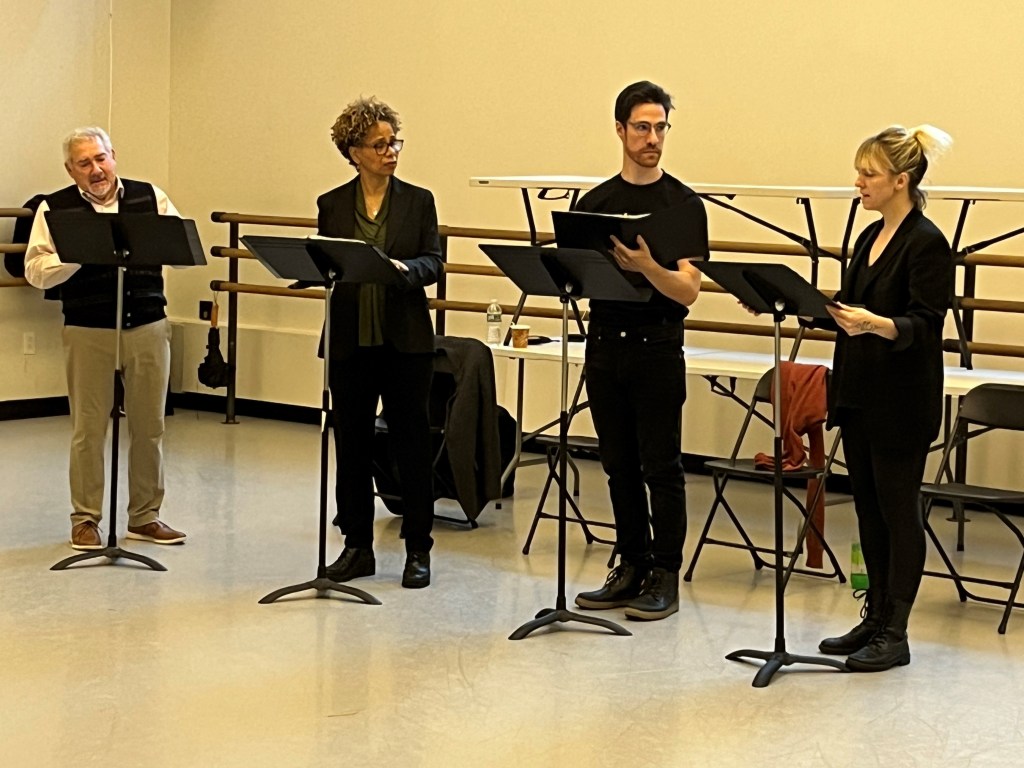
So busy, it seems, that I’m afraid I’ve rather neglected this blog, and am therefore eager to offer some updates and information to catch things up to the present. My most significant accomplishment of 2023, I would say, was completing my newest play, “Featherbaby,” a three actor comedy with dramatic elements, narrated by a parrot. The first draft was completed in the early part of 2023, then revised a bit through a process of sending it to some very smart people whose opinion I trust. In the summer, we held a small reading in the studio at Spreckels Performing Arts Center, assisted by actors Danielle Cain, Matt Cadigan and Brett Molik, with a small invited audience, also filled with smart people whose opinions I respect and value.

Watching the cast read through the “play “Featherbaby” – and then engaging in a post-reading feedback session with the audience – was incredibly valuable. As a result, I went back to work, made some signigicant revisions, threw out my original ending and devised somthing even better, and now have a strong working script, ready to take into production. I should know soon where “Featherbaby” will have its world premiere, and will announce it here.

In January of 2023, director Bob Ari organized an industry reading of my play “Galatea,” presented in New York City for a number of producers and other theater artists. A few important connections were made, and in the future I hope to announce a bit of progress towards a New York City production of “Galatea.”

I’ve applied for a number of grants and fellowships, a fascinating and time-consuming process that could lead to having a bit more time and resources to put towards future projects.

I continue to work full time as the Community Editor of the Argus-Courier, a rewarding job that allows me to write and work with a number of very talented journalists. My column “Culture Junkie” took the second place prize for best nespaper column in the California Newspaper Publishers’ Association’s annual statewide awards presentation. It won third place a few years aga. This year I’m going for First Place.

Additionally, last year I began an adaptation of my 2012 play “Pinky,” a two-actor romantic comedy in which two adult performers take turns telling a story of their accident-prone teenage courtship many years ago, each actor morphing into all of their D&D-loving friends as they act out the tale. Since its premier 12 years ago, the play has had several productions, and has proven to be popular with teenagers, since it is, after all, about teens. With high school drama programs and colleges often in search for new plays featuring teenage characters, I’ve decided to create a second version of the play, to be titled “Beast Hearts Beauty,” in which all of the high schoolers are played by young actors. It will have a cast of 12. And I’m having a blast with it. I hope to workshop the new version later this year.

That’s just the basics, but there you go.
Looks like 2024 is going to be even busier than 2023, but I’m making it a priority to offer more requent updates and musings here.

Industry Readings for ‘Galatea’

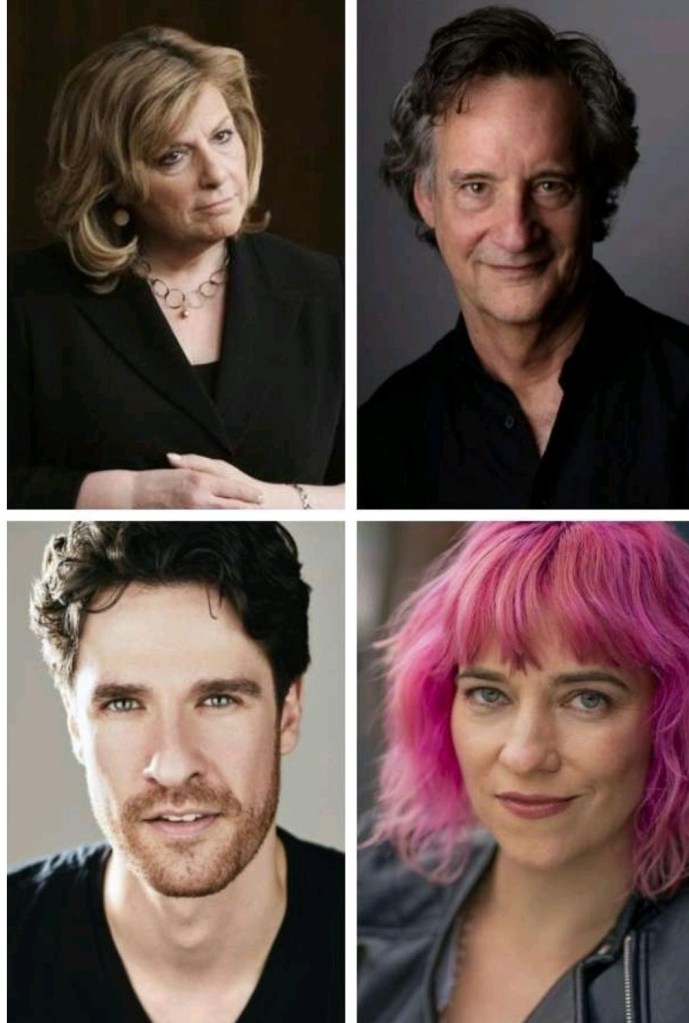
David Templeton’s award-winning mystery-thrilled “Galatea” was debuted in two industry readings in New York City in September of 2022 and again in January of 2023. The readings, with several dozen theater-makers in attendance over the two events, were held at the Manhattan Movement and Arts Center, and were directed by Bob Ari, a director and actor who will be featured in the upcoming musical “Rock and Roll Man” in NYC. The cast of the September reading was Caroline Aaron as Dr. Mailer, Mel House (Marie in ‘Hot Angry Mom’) as 71, John Rothman (‘Sophie’s Choice,” ‘Ghostbusters,” ‘One Mississippi’) as Dr. Hughes and Ben Mehl (Dante Ferguson in ‘You’) as 29, with Kim Sykes (Judge Foley on ‘Bull’) reading the stage directions. The January reading shifted the cast a bit, with Sykes reading Dr. Mailer, Stuart Zagnit (Professor Oak on ‘Every Pokemon Ever’) as Dr. Hughes, and House and Mehl repeating their roles as 71 and 29. Karen Ari read the stage directions. Feedback was quite positive, and conversations are currently underway with select attendees, with the goal of moving toward an eventual production of “Galatea” in New York City in the future.

‘Polar Bears’ warm-up performances in Sonoma County

David Templeton’s “Polar Bears: A True Story About a Very Big Lie,’ will have three WARM-UP performances in Sonoma County before heading to New York City where the show will be performed at the United Solo Theatre Festival on Oct. 25
TONIGHT: Thursday, Oct 13, St. Paul’s Episcopal Church, 7 p.m. – donation at the door
SATURDAY, Oct. 15, 7:30 p.m. (with 6:30 reception) at Artaluma in Petaluma ($25-$30) – DavePokornyPResents.com
WEDNESDAY, Oct. 19 – Main Stage West in Sebastopol, 7 p.m. (MainStageWest.com

Performed by the author, this hilarious and heart-breaking solo show tells the story of a young father, eager for his kids to believe in Santa longer than he did (he was four when he recognized the polar bear wrapping paper “Santa” used on his Christmas presents), who becomes increasingly obsessed with all the details of the perfect Christmas experience. When a family tragedy strikes, he puts his Christmas creativity to work building a new life with his kids, but when the Santa-adjacent fantasy he so meticulously created starts to spiral out of control, everything takes a surprising and unpredictable turn.

New York City

Well, in one week, I will be in New York City, where an industry reading of my play ‘Galatea’ will take place at the Manhattan Movement and Arts Center on Thursday, Sept. 8.

Directed by Bob Ari, the reading features a cast that includes a couple of legends: Caroline Aaron (who plays Shirley Maisel on “The Mazing Mrs. Maisel”) and John Rothman (whose many memorable on-screen moments include being the librarian to whom Bill Murray says “Back off, man! I’m a scientist!” in “Ghostbusters”). Mel House and Ben Mehl complete the cast.

So what, exactly, is an “industry reading”? It’s where theater folks from the NYC area and beyond are invited to a professional presentation of a new (or new-ish) play, which is not fully acted out with costumes and props and sets and blocking, but simply read aloud from the script. If you have never been to one, they are a lot of fun, a blend of words and imagination, and very effective at giving people a sense of what this play could become when fully staged. And that, of course, is the hope: that someone in New York will see the necessity of “Galatea” being given a full production off-Broadway in the near future.

I will be attending, thanks to Mr. Ari, who is hosting me, and to some friends who’ve offered to underwrite the expenses of flying to the East Coast. As it so happens, this is be just the first of at least two trips I am taking to New York this fall, since I will be returning there in October to perform my solo show “Polar Bears” at the United Solo Theatre Festival at Theatre Row on 42nd Street.

Link to Polar Bears GoFundMe site

I intend to post often throughout the next several weeks, updating supporters on what I’m up to and how things are going. I will try to include photographs (when I remember to take them!). Meanwhile, you can support me by sharing this blog/website with others who might be interested, and by visiting my GoFundMe site where I continue to raise funds to make all of these projects possible. Thanks, as always, for your participation in my adventures.

By the way, stay tuned for information about the Polar Bears warm-up performances I will be giving in mid-October in preparation of my trip to United Solo at the end of the month. Currently, it looks like I will be giving at least four performances in the weeks before I leave, in Petaluma, Sebastopol, Healdsburg and Napa. Information coming soon.


Why I write plays

Monday, July 5, 2022


I am, on occasion, asked why I write plays (instead of say, movies or television shows, which I am certainly open to doing), and specifically why I write about the things I do: ghosts and monsters and robots and deities, outcasts and rejects and dreamers and losers, aging heavy metal fans and foul-mouthed parrots and people who fall in love with each other while playing Dungeons and Dragons.
My answers, as if somehow channeled directly from the sweet, damaged dreamers that so often end up with featured roles in my stories, are as lofty and noble as they are foolish and over0reaching and ultimately unachievable.

cropped-anubis101.jpg

I write plays, — stories created specifically for live theatrical presentation — because theater is intimate and dangerous, because it’s one of those wildly beautiful artforms where you are in a room breathing the same air as the people who are making the art for you (a much scarier commitment these days than perhaps in the past). I write plays because I believe they have a unique power to calm people and soothe people and delight people and scare people. I want to rattle people so hard, or make them laugh so deeply, that they need a chiropractor in the morning. I also want to pass them a couple of ibuprofen and a diagram of stretches they might want to try before going to sleep that night. Basically, I want them to leave the theater a slightly but detectably different person than when they entered and took their seat.
Plays can do that, in a way I genuinely respect and enjoy.
As for why I write plays about the curiously offbeat characters I do, my answer is simple. I love them.

If there is a better reason to write about anything, or to write at all, I’d like to know.